
What comes after the licence
The licence says that you can fly. The ratings say what you can fly, and where. They are short courses, almost all of them made of flying rather than classroom time, and they are the moment when a pilot stops repeating what he has learned and starts really learning. At our school two of them — tailwheel and variable pitch propeller — are not a matter of taste: they are the practical prerequisites for glider towing and for mountain flying.
Variable Pitch Propeller
With a fixed-pitch propeller the engine does what it can. With a variable pitch propeller you choose: high rpm and plenty of thrust when you have to get off a short strip, low rpm and an unhurried engine when you are cruising. It is the first time a pilot realises he has a machine in his hands, and not a means of transport.
It is not a separate licence: it is differences training, added to what you already hold. It is flown with an instructor, it ends with an endorsement in your logbook, and there is no test with an external examiner.
What you learn
How a constant-speed propeller and engine work together, which combinations of power and rpm are right in each phase of flight, how to manage the engine parameters without mistreating it, and what to do if the governor stops governing. The rest is taught by circuits: take-offs, climbs, cruises and go-arounds until your hand finds the two levers by itself.
How long it takes depends on how much you have flown so far: this is training measured in a few hours of flying, not in months. For a current quotation and for realistic timings, ask at the office.
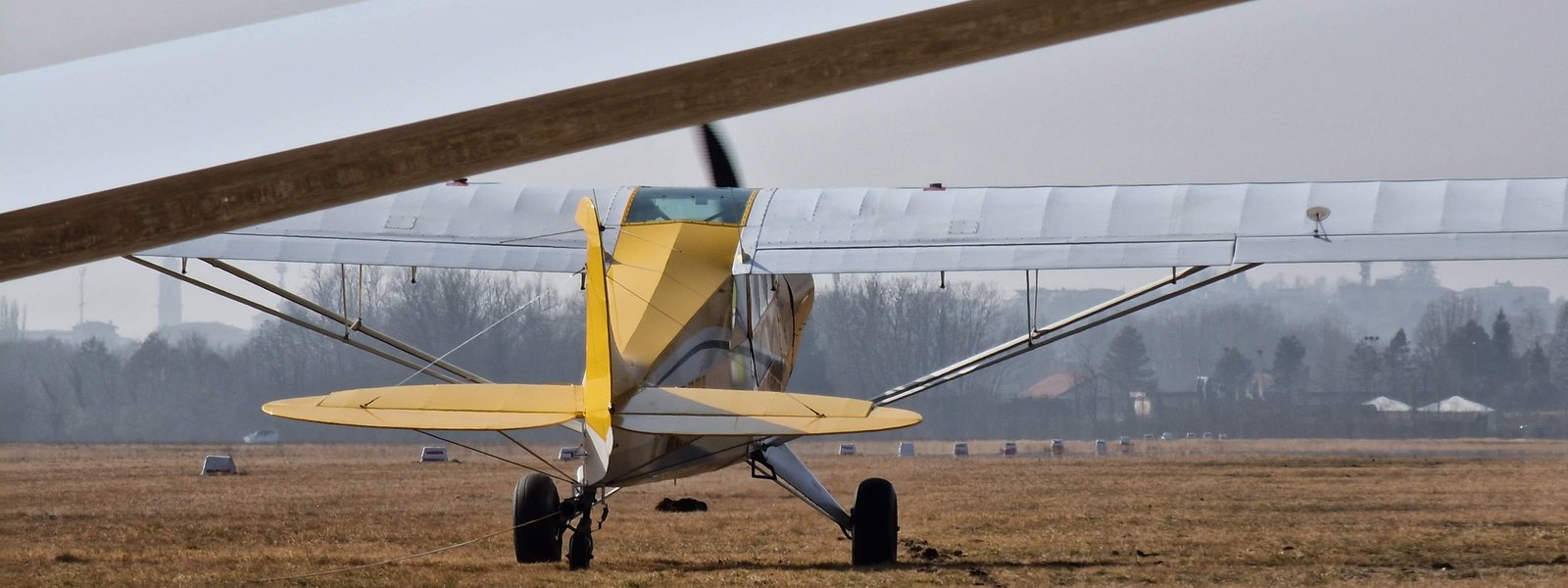
Together with the tailwheel, it is one of the two practical requirements for mountain flying and for glider towing: the school’s Husky is a tailwheel aeroplane with a variable pitch propeller, and nobody flies it before holding both.
Tailwheel Aeroplanes
A tailwheel aeroplane forgives nothing on the ground: the wheel that steers is behind you, and the machine always wants to turn round. Whoever learns to keep it straight discovers that he has flown for years without really using his feet. It is the most honest school of airmanship there is, and it is the reason why mountain pilots all start here.
This is differences training, not a new licence: it is flown with one of the school’s instructors and it ends with an endorsement in your logbook.
What you learn
Taxiing in a crosswind, keeping straight on take-off with your feet, the three-point landing and the wheeler, the go-around, and above all what to do in the first instant when the tail decides to overtake you. You fly circuits, a great many circuits, with a different wind every day: there is no other way to learn it.
How it works
The rating is awarded after no fewer than four hours with an instructor and one flight on a hard surface. The aircraft used is the Aviat Husky A-1-180, a perfect machine for the job.
It is the first of the two compulsory steps towards mountain flying: on a sloping strip a tailwheel is not a matter of style, it is the aeroplane that gets there.
Glider Towing
Every glider flight starts with somebody taking you up. At Belluno the gliders fly because there are Club pilots who have taken the towing rating and who spend their weekends at the end of the runway sending everyone else into the air. It is technical, demanding and strangely beautiful flying: two machines tied together by a rope, which have to think the same thing at the same moment.
The Club trains its own tug pilots because it needs them: the gliding school cannot depend on whoever happens to be passing. If you already fly powered aircraft and feel like making yourself useful, this is the rating we ask you to take — and it gives you a great many flying hours back.
What you need to start
The glider towing rating is governed by EASA FCL.805. To begin you need:
- a current PPL(A) or CPL(A) licence;
- at least 30 hours of flight time as pilot in command of aeroplanes;
- at least 60 take-offs and landings in command, after the licence was issued.
How you learn it
The course is run at a certified school — ours is a DTO — and falls into three parts:
- Theory: towing operations, techniques and safety procedures.
- Flying: at least 10 training flights towing gliders, of which at least 5 dual.
- Familiarisation: anyone without an SPL licence makes 5 flights on board a glider launched by aeroplane, to find out what happens at the other end of the rope.
What it involves
A tug pilot is part of the team that puts the gliding school into the air: the days are long, often with several tows one after the other, and you become very precise very quickly.
For information and enrolment, your point of contact is always the club office: write to us using the contact form.
Mountain Flying (MOU – EASA FCL.815)
The rating for the use of sloping airstrips, snow-covered or icy. The Powered Flight School of Belluno has offered it since 1999 and is today the only school in Italy to do so.
Tailwheel and variable pitch propeller, the two ratings above, are the practical prerequisites for getting there.
Back to all the Flight School courses
Ready for Take-Off?
Course fees and the membership subscription are updated year by year: for a current quotation and to book a trial flight, get in touch with the office. The sky is waiting!
Request Information